KICKER, The Other Football Simulation
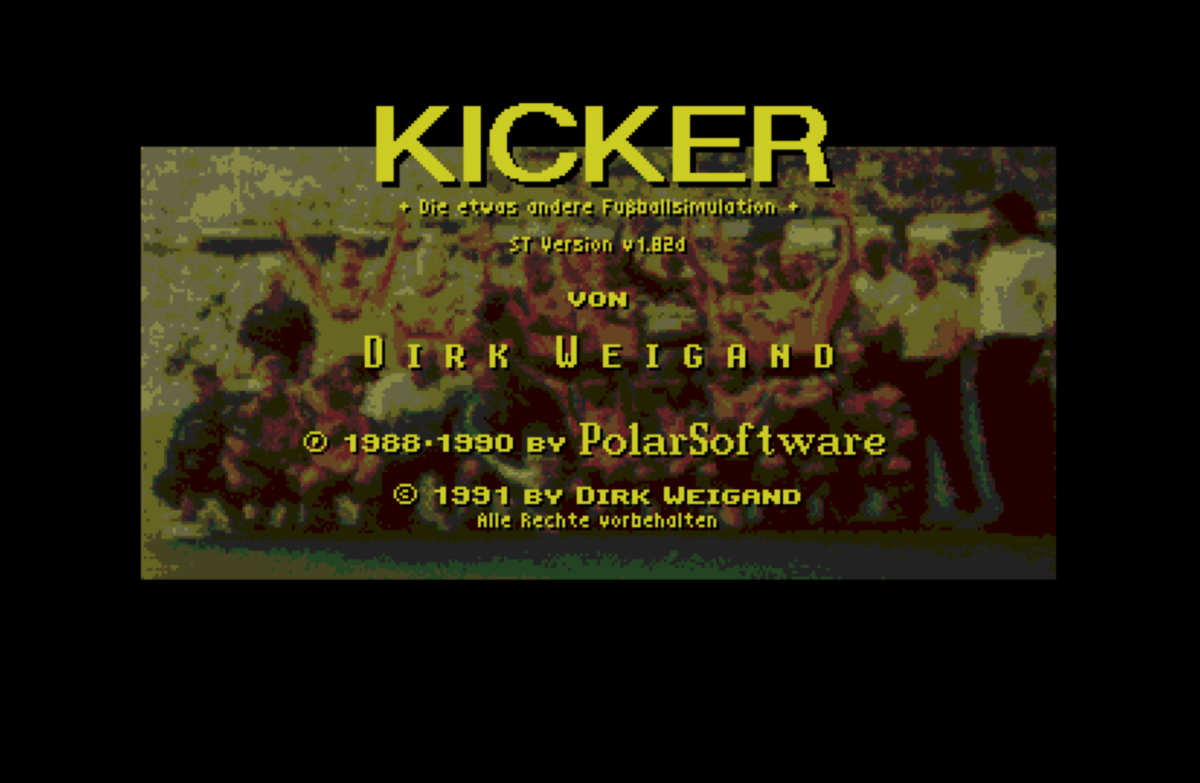
MEMORIAL
“Welcome to the best (and probably only) fan site on the web for the Atari ST game KICKER from 1991, and its commercial successor Starbyte Super Soccer. This tribute was created by my ‘big’ brother Frank, the greatest admirer of this game that I know. Closely followed, of course, by Kicker Bernd... Thank you so much, dear Frank, for this wonderful memory! Your ‘little’ brother Dirk!”
The Game
KICKER is a football manager simulation for the Atari ST, developed from 1987 by Dirk Weigand in GFA-Basic. Inspired by the Football Manager (1984) on the ZX Spectrum, it was one of the first German-language football managers ever made. In 1991 it was commercially released as Starbyte Super Soccer for Atari ST, Amiga and PC, receiving consistently positive reviews from the German gaming press. The game was never released outside Germany – all menus, player names and content are in German.
Features
- 4 leagues (regional league to Bundesliga)
- German and international cup competitions
- Over 700 authentic players, 100+ clubs
- Sophisticated menu system with mouse control
- Graphical match scenes
- 1–6 players
- Player transfers, training camps, squad management
- Advertising, stadium expansion
- Graphical statistics and league tables
- Custom "football worlds" with individual rules
Screenshots
The origins of KICKER go back to a programming experiment. In the mid-1980s, we (Bernd, Dirk and Frank) had been addicted to the game “Football Manager” on the Sinclair ZX Spectrum for months. My ‘little’ brother Dirk, still a teenager, had the idea to develop a German version inspired by this grandfather of all football manager games.
He tinkered with making this vision a reality on his Atari 600 XL. Unfortunately, the implementation failed simply due to lack of memory – the Atari had just 16 kilobytes. But at least: match results were calculated based on a team model with various parameters, or – as he puts it today – rolled like dice. The team lineup and a few tables were already implemented. But that was as far as it went.
Dirk’s confirmation and generous relatives from Switzerland then made it possible to acquire an Atari ST computer. An absolute dream machine! With that, there was no more excuse about RAM. Dirk started a new attempt and first ported the algorithm for calculating results.
Instead of relaxing and doing nothing, my little brother spent the summer holidays of 1988 coding KICKER from early morning until late at night on his ST. The nights were especially short because Bernd, Dirk and I (Frank) preferred to use them for extensive play and test sessions. Many new game ideas were conceived during these sessions and often implemented by Dirk the very next day.
The programming language of choice was the then very popular GFA-Basic 2.0. Dirk was self-taught. The semi-structured code looked accordingly – memory management, meaningful variable names or inline documentation? None of that! Yet GFA-Basic offered enough possibilities to realise Dirk’s vision and just barely manage its complexity.
Two features were implemented via external assembler libraries: the freely scalable and pixel-precise font, and the (theoretically possible) 16-colour sprites for displaying match highlights at the end of each matchday. These were contributed by an older programming colleague of Dirk’s – special thanks to Oliver Merklinghaus!
Incidentally, the library “iconomic” and its sprite editor by Dirk were the “Listing of the Month” in the Atari Magazine, January 1989 issue.
At some point KICKER was “finished” and distributed among friends and acquaintances. How KICKER reached the famous German gaming magazine ASM is not entirely clear. It was featured in their “Microwelle” column in the August/September 1990 issue.
Around the same time, the company Micropartner (operating under the Magic Bytes label) offered to market KICKER professionally. Unfortunately nothing came of it, as the company failed to port the game to other platforms. The contract was dissolved at the end of 1990.
A few months later, Dirk managed to publish a reader’s letter in ASM announcing that KICKER would be offered as shareware in self-distribution. To save your game, you had to purchase a manual with save code table for 30 DM. Shortly afterwards, the first orders trickled in. From memory, up to 100 copies were sold. KICKER was also distributed on various shareware CDs of the time.
In early 1991, the German games company Starbyte Software took notice of our football manager. The directors promised a commercial release, and inexperienced as we were, we quickly agreed on a contract. In addition to the Atari ST version, ports to PC, Amiga and C64 were planned.
Under the rather unoriginal name Starbyte Super Soccer, KICKER was released for the Christmas market at the end of 1991, at least for ST and PC, followed by the Amiga version. Enhanced with a new title screen, music and real stadium sounds but otherwise largely unchanged, Starbyte Super Soccer collected a series of very good reviews in the German gaming press.
We were particularly proud of the 80% rating from Heinrich Lenhardt, the godfather of German games journalism, in Powerplay magazine. Starbyte Super Soccer even made it onto the Powerplay top 100 list in their 1991 special issue.
What could have gone wrong? For one, the simultaneously released Bundesliga Manager Professional, in whose long shadow Starbyte Super Soccer clearly stood. Not to mention Anstoss, which appeared a year later. And secondly, the bankruptcy of Starbyte Software shortly after release.
So Dirk did not become rich from SSS in the monetary sense. There were problems with the very first contractually agreed payments. Unfortunately, Starbyte folded shortly after the game’s release in 1992. Or as Dirk’s lawyer put it in legalese: “The GmbH had apparently dissolved silently without legal successor.”
A year later, Starbyte resurfaced in Bochum with a slightly changed name and a new managing director. SSS was re-released and later bundled in various game collections. But by that point we had barely noticed – Dirk had already written off the game and was mentally immersed in university and a new chapter of his life.
KICKER, or Starbyte Super Soccer, nevertheless gave many players a wonderful time and left lasting positive memories. The fantastic article on Videospielgeschichten.de by Denis is the reason this KICKER Memorial Page exists, and why Dirk, after nearly 30 years, even provided a new version with a bugfix for unrecognised mouse clicks, allowing KICKER to be played in emulation without floppy disk swapping.
Starbyte Super Soccer Screenshots
The Interview
Denis Roters, the author of the wonderful article “How Starbyte Super Soccer came into my life”, hears the true story behind the game from Dirk. Dirk talks about the origins and reveals some technical details – and why Starbyte Super Soccer did not make him happy (or rich). For the truly dedicated, here is the full 2.5-hour interview (in German).
Also available on YouTube.
Press Reviews
Translated from the original German reviews.
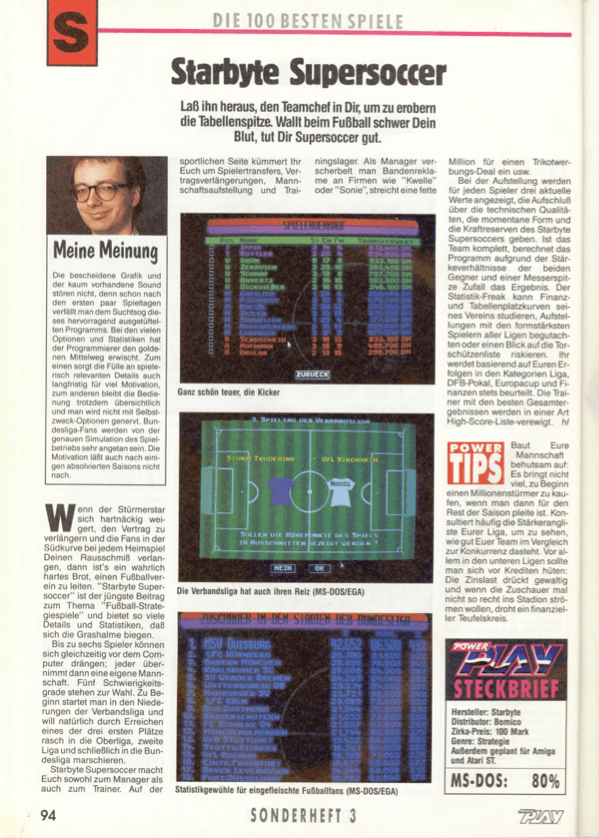
„After just a few match days you fall under the addictive spell of this excellently crafted program... With all its options and statistics, the programmer has hit the golden mean.“
— Heinrich Lenhardt, Powerplay
Wertung: 80%
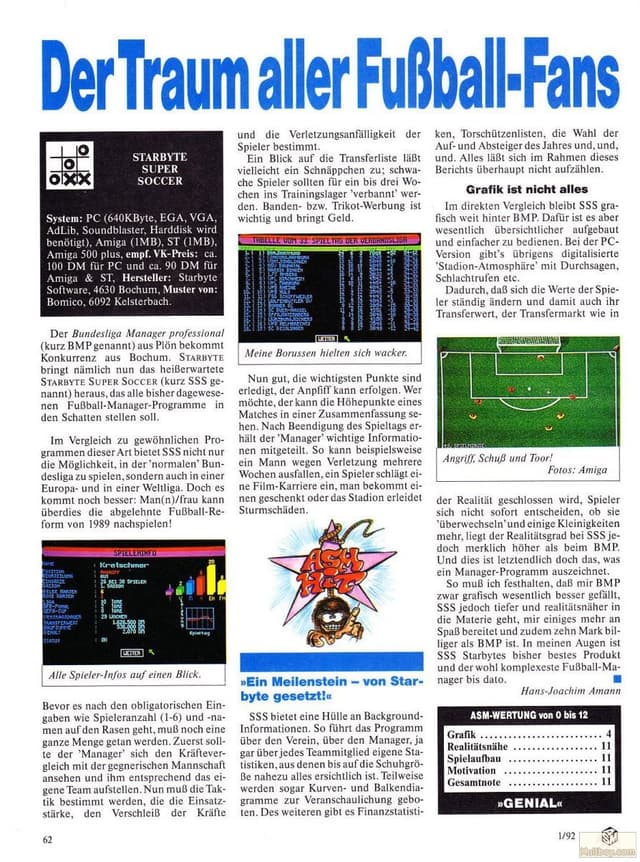
„The dream of every football fan: "Genius", "A milestone", "Graphics aren't everything", "In my eyes SSS is Starbyte's best product to date..."“
— ASM Magazine 1/92
Wertung: 11/12 (ASM Hit)
„The more absurd the club name, the more enthusiastic I was... The game immediately became my great love... Perhaps "Starbyte" is the most important game of my life.“
— Denis Roters, videospielgeschichten.de
Ganzen Artikel lesen →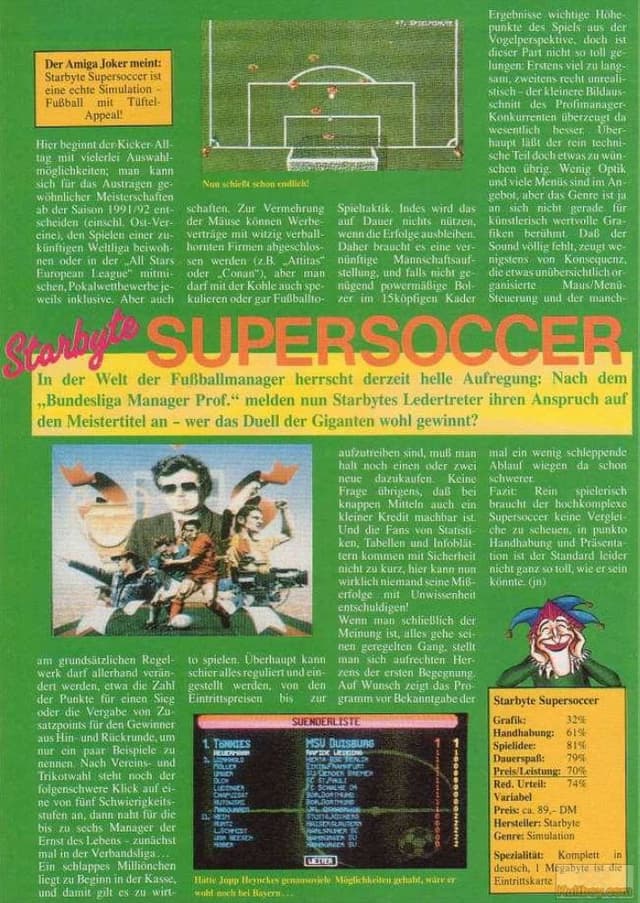
„In terms of gameplay, this highly complex football manager need not fear any comparison... After Football Manager Professional, Starbyte's leather kicker now stakes its claim for the championship title.“
— Amiga Joker 12/91
Wertung: 74%
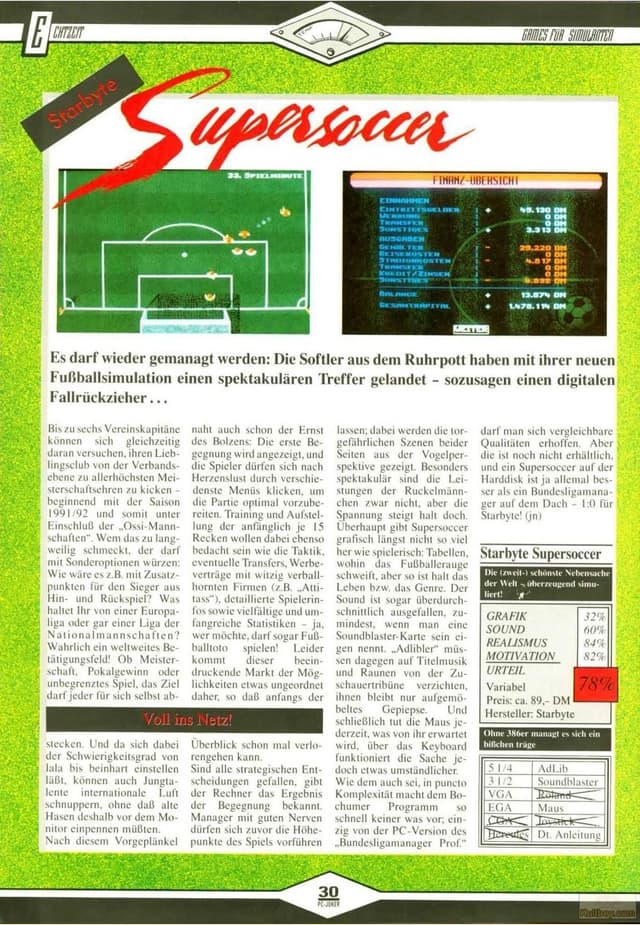
„Straight into the net!... The software team from the Ruhr valley have scored a spectacular goal with their new football simulation... In terms of complexity, nothing comes close to this program... 1-0 for Starbyte.“
— PC Joker 6/91
Wertung: 78%
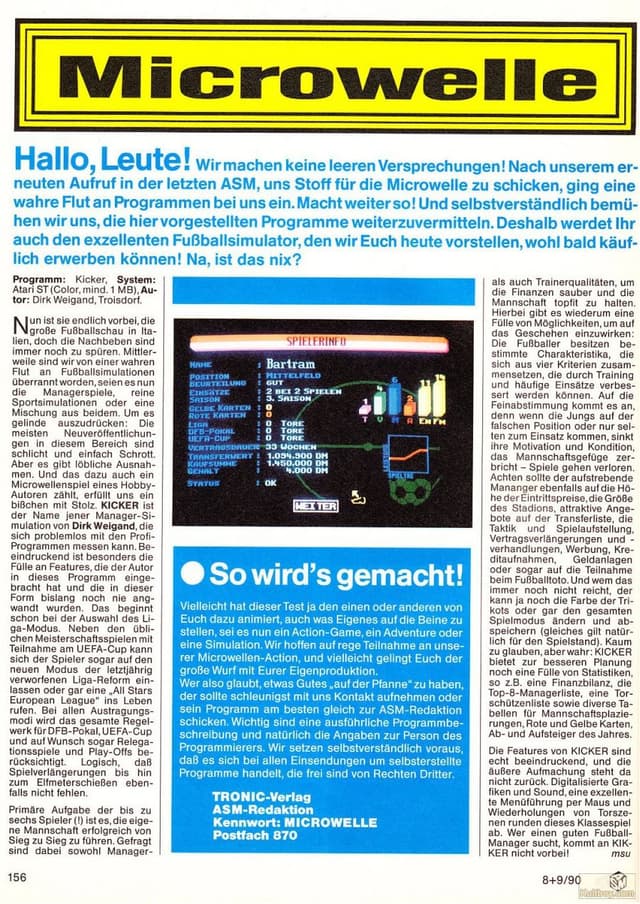
„If you're looking for a good football manager, you can't get past KICKER... KICKER can easily compete with the professional programs.“
— ASM Microwelle 8+9/91
The Revival
After more than 30 years, Dirk rediscovered the source code and revised it – approximately 20,000 lines of GFA-Basic.
A persistent bug in the mouse click detection at program start was identified and fixed. The emulated version now works reliably without disk swapping.
KICKER REVIVAL on GitHub →Download
Frequently Asked Questions
What is KICKER?
KICKER is a football manager simulation developed from 1987 onwards by Dirk Weigand in GFA-Basic for the Atari ST. In 1991 it was commercially released as Starbyte Super Soccer for Atari ST, Amiga and PC.
Was KICKER ever released outside Germany?
No. Both the original KICKER shareware and the commercial release Starbyte Super Soccer were exclusively published in Germany. The game, its menus and all player data are entirely in German. This memorial page offers an English version so international retro gaming enthusiasts can learn about this piece of Atari ST history.
What systems can I play KICKER on today?
KICKER can be played on Windows, macOS and Linux via the Atari ST emulator Hatari. Ready-made packages with a pre-configured emulator are available in the download section for Windows and macOS.
Is KICKER free?
Yes, KICKER is available as a free download. The original shareware version including the manual and save codes can be downloaded at no cost.
What is the difference between KICKER and Starbyte Super Soccer?
Starbyte Super Soccer is the commercially published version of KICKER. It added a new title screen, music and stadium sounds, but the gameplay is largely identical to the original.
Is the source code available?
Yes, Dirk Weigand has published the original GFA-Basic source code (approx. 20,000 lines) on GitHub. The revised version 1.82d with bug fixes is also available there.
News
News articles are written in German.
12 April 2026
Hallo kicker-atari.de und Tschüss kicker.weigand.xyz
15 December 2023